About Digital Oil Bath
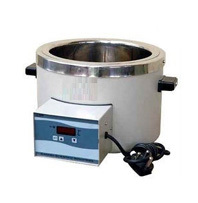
Digital oil bath is an appliance that accurately heats and maintains oil's temperature using electronic controls, usually for laboratory applications. It typically comprises of a heating element, a digital controller, and an oil-filled metal chamber. Within a relatively small range, the controller enables the user to select and maintain the desired oil temperature. To heat reaction mixtures or to keep a steady temperature during an experiment, digital oil bath is frequently utilised. It is a dual-purpose laboratory heating device made for maintaining a steady, temperature-controlled outside environment.
Advanced Temperature Control and SafetyExperience precise heating with the digital microprocessor-based PID controller, capable of maintaining temperatures from ambient up to 300C. The system incorporates multiple safety features, including over-temperature protection, an audible alarm, insulated handles, and robust double-walled construction. These safeguards ensure user and equipment safety during prolonged operations.
Durable and Efficient DesignEngineered for durability, this digital oil bath incorporates a corrosion-resistant SS 304 inner chamber and a powder-coated mild steel exterior for long-lasting use. The effective glass wool insulation minimizes heat loss, ensuring optimal energy efficiency and uniform temperature distribution throughout the bath.
Versatile Applications in Laboratory and IndustryWith a 12-litre capacity and universal design, this oil bath is ideal for a broad range of laboratory, research, and industrial heating needs. Its static circulation can be upgraded to an optional magnetic stirring model, offering flexibility for various temperature-sensitive applications and sample preparations.
FAQ's of Digital Oil Bath:
Q: How do you operate the Digital Oil Bath safely in a laboratory environment?
A: To use the Digital Oil Bath safely, place the apparatus on a stable, heat-resistant surface and connect it to a 220V AC power source. Add the required oil up to the recommended level, close the lift-off stainless steel lid, set your target temperature on the digital controller, and allow the system to stabilize before introducing samples. Always use insulated handles and heed the audible over-temperature alarm for maximum safety.
Q: What are the benefits of the digital microprocessor-based PID controller in this oil bath?
A: The microprocessor-based PID controller ensures accurate temperature control (1C), minimizing fluctuations and providing consistent heating performance. This precision is vital for research and industrial applications where reproducibility and reliability are critical.
Q: When should the optional magnetic stirring model be considered?
A: The optional magnetic stirring model is recommended when uniform mixing or homogenous temperature distribution is required for specific samples or processes. It is especially useful for research workflows that involve complex reactions or require constant agitation during heating.
Q: Where can the Digital Oil Bath be used effectively?
A: This oil bath is suitable for use in laboratories, research facilities, and industrial settings across India, where precise, safe, and uniform heating is needed for sample preparations, chemical reactions, or temperature control applications.
Q: What process does the Digital Oil Bath use to achieve minimal heat loss?
A: The equipment features double-walled construction with glass wool insulation, which significantly reduces heat transfer to the outer body. This design improves energy efficiency and ensures that the desired temperature is maintained with minimal power consumption.
Q: How does the over-temperature protection feature work?
A: An integrated safety circuit constantly monitors the oil bath temperature. If the set point is exceeded, the system activates an audible alarm and interrupts the heating process, preventing equipment damage or safety hazards.
Q: What makes the Digital Oil Bath suitable for corrosive laboratory conditions?
A: Its inner chamber is made from corrosion-resistant SS 304 stainless steel, and the outer body is powder-coated mild steel. These materials ensure durability even in harsh chemical environments, making it a dependable choice for routine and demanding laboratory tasks.

 Send Inquiry



 Send Inquiry


 Send Inquiry


