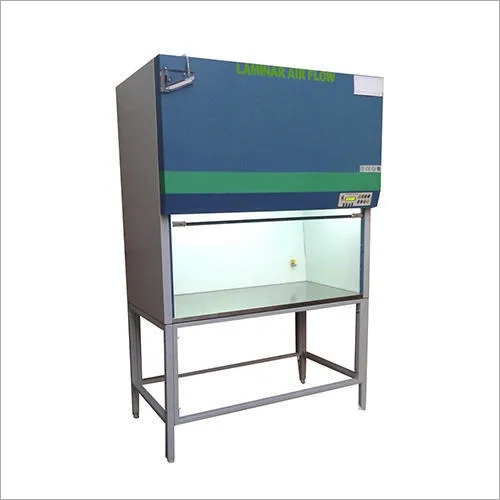
About Laminar Air Flow
Feature
- HEPA filter of 0.3 µ of an efficiency of 99.97 % down to 0.3 µ.
- Pre filter (10µ) of dry fiber washable type with the frame on all the sides.
- Confirm international standard 209 E
- Statically balanced motor blower assembly (heavy duty)
- Velocity at the output of HEPA is 90 + 20 RPM
- Noise level is very low.
- Vibration is also very low
- Normal working fluorescent light.
- Static pressure monometer.
- U.V light.
- Front & side door of acrylic sheet (transparent)
- Gas cock.
Superior Clean Air for LabsOur horizontal Laminar Air Flow system guarantees a sterile working area by directing a steady, uniform stream of filtered air. Crafted with robust stainless steel, it resists corrosion and simplifies cleaning, making it ideal for laboratories where contamination control is critical.
Engineered for Reliability and EaseDesigned and manufactured in India, this unit combines durability with user-friendly operation. Its horizontal airflow design reduces turbulence, ensuring sensitive samples and procedures remain unaffected by airborne particles.
FAQ's of Laminar Air Flow:
Q: How does the stainless steel horizontal laminar air flow system operate in a laboratory setting?
A: This system draws ambient air through a HEPA filter and directs it horizontally across the workspace, constantly sweeping away contaminants and maintaining a clean environment for critical laboratory processes.
Q: What applications are best suited for this laminar air flow unit?
A: The unit is ideal for laboratories engaged in research, pharmaceutical preparations, microbiological experiments, and sensitive electronic assembly-any process where a sterile and particle-free atmosphere is essential.
Q: When should a laminar air flow unit be used in laboratory procedures?
A: It should be employed whenever samples, instruments, or work processes require protection from airborne particulates, particularly during sterile media preparation, specimen plating, or assembling delicate components.
Q: Where is this laminar air flow system typically installed?
A: It is generally installed on laboratory benches or specialized workstations where clean air is necessary. Its compact, horizontal design allows it to fit efficiently within most laboratory layouts.
Q: What is the process of maintaining the stainless steel laminar air flow unit?
A: Routine maintenance involves regular cleaning of the stainless steel surfaces, periodic replacement of pre-filters and HEPA filters, and monitoring airflow velocity to ensure optimal performance.
Q: How does using this system benefit laboratory workflows?
A: It significantly reduces the risk of contamination, promoting more accurate results and safer procedures. Additionally, the stainless steel construction ensures longevity and easy sanitation, thereby supporting consistent laboratory operations.

 Send Inquiry



 Send Inquiry


 Send Inquiry


